

Environmental First Response in the Wake of the UPS Plane Crash
One Year Later, EEC’s Emergency Response Team Members Reflect on their Work
By Kirsten Delamarter
It’s not uncommon for EEC’s Emergency Response Team to be among the first to arrive on scene after a major incident that has environmental impacts. They’ve responded to rickhouse fires that sent bourbon flowing into nearby streams, train derailments that released sulfur dioxide into the air.
But last year’s UPS plane crash in Louisville was on a scale seldom experienced by longtime ERT members.
“Of my 27 years that I had worked with the Emergency Response Team, we’ve only worked two plane crashes,” said Mac Cann, science and safety officer for the Department for Environmental Protection and the Emergency Response Team. “The UPS plane crash taxed our resources to the absolute maximum of what we can do.”
At approximately 5:15 p.m. on November 4, 2025, a UPS plane crashed shortly after taking off from the Muhammad Ali International Airport. The left engine separated from the wing, caught fire and tumbled over the aircraft, the National Transportation Safety Board would find. The fire spread, and the plane crashed into several nearby businesses, including an auto scrap yard and a petroleum recycling facility.
The crash left 15 people dead.
ERT On-Scene Coordinator Denise Dzurenka, an Environmental Control Supervisor at the Division of Waste Management’s Louisville Regional Office, was the on-call responder that day. She arrived on scene around 6:30 p.m.
“On the way there, I knew this was too big for one person,” she said.
In the hours and weeks following the incident, Dzurenka served as part of United Command, a system that allows emergency responders from different agencies to effectively establish priorities, manage resources and make decisions.
ERT is comprised of individuals from the Division of Waste Management, Division of Water and Division for Air Quality within the Kentucky Energy and Environment Cabinet.
“They are full-time scientists and in addition to that, they are part-time responders,” Cann said. “That is the strength of the Environmental Response Team.”
In the first 18 hours after the crash, ERT’s main focus was emergency air monitoring.
Because the plane crashed into a petroleum recycling facility and caused a large fire, there was immediate concern that hazardous materials — including hydrogen sulfide, carbon monoxide and volatile organic compounds — had been released into the air. As more than 100 firefighters worked to control the blaze that evening, emergency management officials issued a shelter-in-place order for those within five miles of the airport.
“We were initially sent out for community air monitoring, which is looking at centers of population, civilians, neighborhoods, that kind of thing,” said ERT Preparedness Coordinator Brent Cary. By around midnight, he said, ERT had its air monitors up and running.
Shortly after, ERT was asked to assist with hot spot air monitoring, which provided data to inform decisions about proper protective equipment for first responders.
“We wanted to ensure that firefighters, the paramedics, anybody that was out doing victim recovery or anything like that was being safe,” Cary said. “We wanted to give them guidance moving forward.”
Once the initial emergency phase of response had concluded, Dzurenka and others began focusing on long-term remediation.
The team worked with UPS and their contractor to review the site and the environmental impact of the crash. This included immediate oil containment and removal, wreckage removal, visually impacted soil removal, and groundwater and surface water testing and treatment to ensure the public was protected.
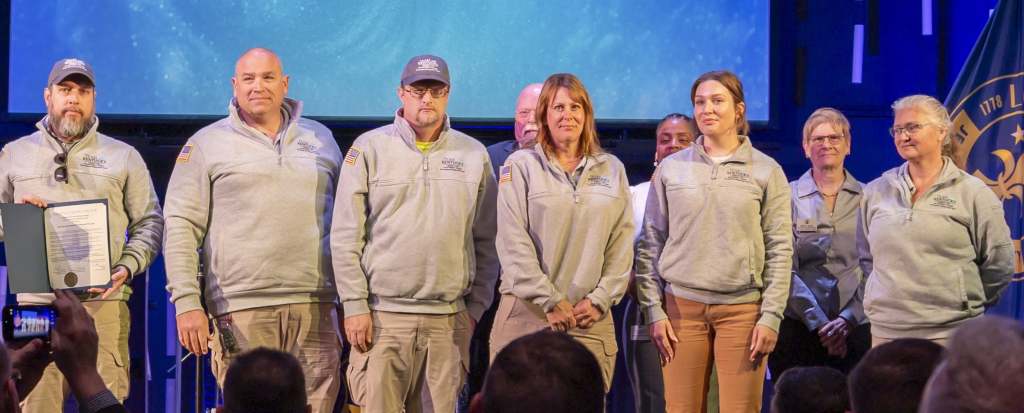
This spring, ERT was recognized by Louisville Metro Council for working alongside other responding agencies after the UPS plane crash.
Some EEC employees who responded to the crash as part of ERT continue working at the site, not in a first responder capacity but rather in their roles as full-time EEC scientists. The site will undergo continued monitoring under the State Superfund program, which will help determine the extent of contamination and guide long-term remediation.
To learn more about the Emergency Response Team, visit eec.ky.gov.
Legal Disclaimer:
EIN Presswire provides this news content "as is" without warranty of any kind. We do not accept any responsibility or liability for the accuracy, content, images, videos, licenses, completeness, legality, or reliability of the information contained in this article. If you have any complaints or copyright issues related to this article, kindly contact the author above.
